
Use diagram panels
New in v0.11.0
A diagram opens in a panel beside the model it came from. What it draws can be a single element, a whole file, or a view, depending on the entry point you used: see Open a diagram for the three of them. This page covers what the panel offers once a diagram is on screen, which is the same whichever of the three it came from. For writing views, see Select what a diagram shows and Configure diagram views.
Controls
The controls a diagram panel offers depend on the engine that rendered it. Select the tab for the engine you are using.
Drag with the left mouse button to pan the diagram, and scroll to zoom. The toolbar in the corner of the panel holds the rest:

re-renders the diagram from the saved file
writes the diagram as an image, see saving a diagram
copies a command that reproduces the diagram on the command line, see syside viz
and zoom by a step, and fits the whole diagram in the panel
The engine renders the diagram as a picture: elements are not selected, moved, hidden or drilled into in the panel, and what it draws is decided by the element, file or view you visualized. Select what a diagram shows covers how a view states what to include, and SysML v2 diagram coverage lists the notation the engine supports.
Diagram type and layout
The Diagram picker chooses the kind of diagram: General, Interconnection, Action flow, State transition or Sequence. The Layout picker arranges children as a tree or nested inside their parents. Changing either re-renders the element, and both choices are kept when the diagram is refreshed or saved.

Both pickers apply to single-element visualizations only. They are greyed out for a view, which states its own diagram type and layout in the model, and for a whole file, where neither applies.
Saving a diagram
asks for a name and
location first, then renders: the format follows the extension you choose, one of
.svg, .png or .jpg. Once the file is written, the notification names the full
path and offers Open.
A saved diagram uses the light theme, while the panel follows your VS Code color
theme. A [viz.style].theme set in syside.toml overrides both. The rest of the
[viz] settings apply to these diagrams as well as to the command line, see
Visualization settings.
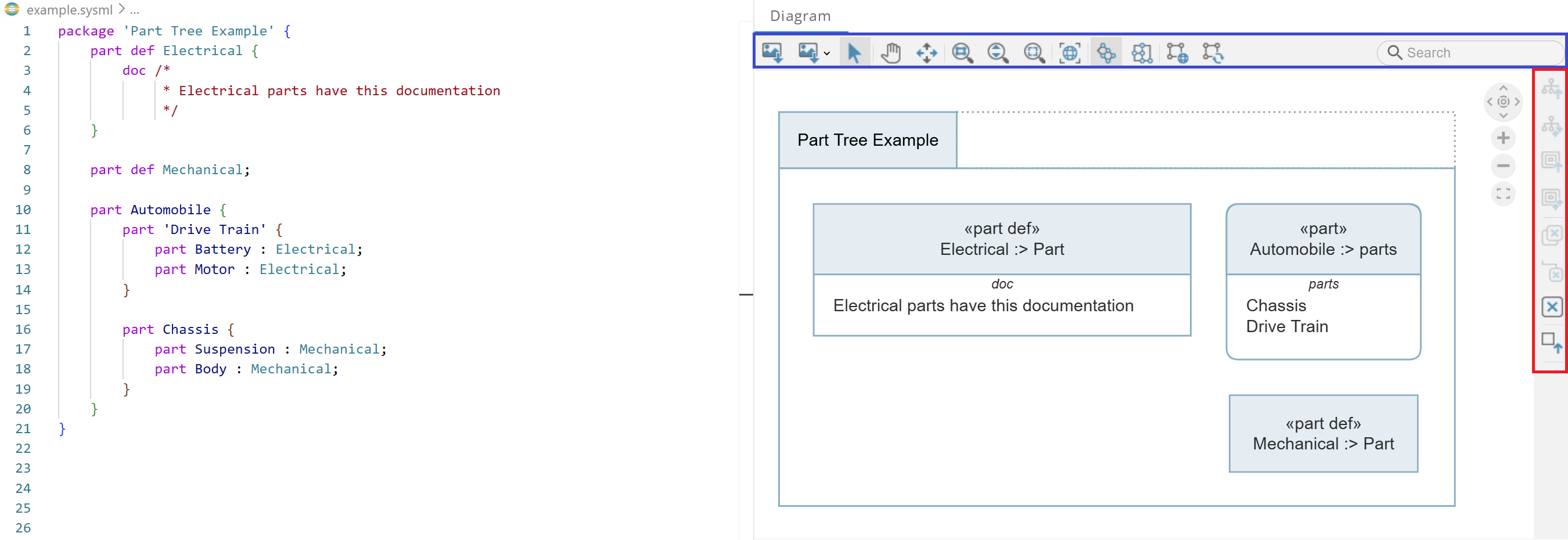
Here is an example of Modeler in action:
Note
Refreshing resets any customizations, such as element layout or visibility settings.
In the diagram view, you can find many different controls that help you navigate and interact with the model. They are organized into two different panels:
View tools (Blue): The horizontal panel at the top containing tools such as “Select”, “Zoom”, “Pan”, “Zoom in”, “Zoom out” and “Fit to screen”.
Context tools (Red): The right-side panel containing tools such as “Show descendants”, “Remove element”, and “Go to source”.
View tools
The View Tools panel provides navigation and layout controls for your diagram. Controls are arranged left to right:

Save As Image - Export current diagram as an image file
Select - Select elements (blue highlight). Multi-select with drag or Ctrl/Command+click
Pan - Move diagram view with left mouse button
Navigate links - Click connections to jump between elements
Marquee zoom - Zoom to area by drawing rectangle
Interactive zoom - Zoom in/out with mouse up/down
Zoom fit - Adjust view to show entire diagram
Overview - Toggle mini-map for navigation in large diagrams
Hierarchical Layout - Arrange diagram in tree structure
Orthogonal Layout - Arrange diagram in orthogonal structure
Global Layout - Auto-arrange entire diagram
Incremental Layout - Auto-arrange while preserving relative element positions
Search - Find and navigate to diagram elements
Also, double-clicking on white space inside of an element (outside of the name box) will “drill down” into it. Similarly, double-clicking on the white space outside of the element moves the view back up one level.
Context tools
The context tools panel provides element-specific operations for diagram manipulation. On macOS, it appears on the right side of the screen; on Windows and Linux, access it by right-clicking an element.

Load Children as Tree - Display immediate children of selected elements
Load All Descendants as Tree - Display all descendants (depends on model complexity, use with caution on large models with 10k+ rows of code)
Load Children as Nested Tree - Display immediate children in nested format
Load All Descendants as Nested Tree - Display all descendants in nested format (depends on model complexity, use with caution on large models with 10k+ rows of code)
Remove Selected - Hide selected elements (preserves descendants)
Remove All Descendants - Hide descendants of selected elements
Remove All - Clear all elements from the diagram
Go To Source Definition - Jump to and highlight element definition in model file
The viewer requires Java, and Modeler detects it automatically. See Tom Sawyer SysMLv2 Viewer if it is installed somewhere Modeler does not find it.