

CLI commands
Command |
Description |
|---|---|
Validate models for semantic errors and warnings |
|
Format SysML v2 models according to a consistent style |
|
Look up Syside validation rules |
|
viz Labs |
Generate diagrams from SysML v2 models |
table Labs |
Generate CSV exports of grid views |
Check command
Validates models for semantic errors and warnings.
Basic usage
Validate specific files
syside check /path/to/analyzed_model.sysml /path/to/analyzed_model_2.sysml
Validate all files in current directory recursively
syside checkNote
When using
syside checkwithout explicitly listing out the files, Syside ignores hidden files and files from hidden directories (starting with., e.g..venvor.git). To analyze files from these directories, list them explicitly.Validate files matching a glob pattern
syside check "models/**/*.sysml"
Path arguments can be files, directories, or glob patterns (
*,**,?,{a,b},[a-z]), mixed freely. Everysysidecommand discovers files with the same rules.
Output
If Syside does not find any errors or warnings, there will be no output. If Syside does find anything, the output will look similar to this:
/path/to/analyzed_model.sysml:5:28: error (type-error): 'Non-Conforming Types 1'::a does not conform to ScalarValues::String
   5 |     attribute b : String = a;
     |                            ^
/path/to/analyzed_model.sysml:12:30: error (type-error): ScalarValues::Integer does not conform to ScalarValues::Positive
   12 |     attribute b : Positive = -42;
      |                              ^^^
/path/to/analyzed_model.sysml:30:27: error (type-error): Collect::A does not conform to Collect::B
   30 |     attribute b : B [*] = (1..10)->collect { in attribute x : Positive; new A(x) };
      |                           ^^^^^^^^^^^^^^^^^^^^^^^^^^^^^^^^^^^^^^^^^^^^^^^^^^^^^^^^
/path/to/analyzed_model.sysml:38:34: error (type-error): ScalarValues::Integer does not conform to ScalarValues::Positive
   38 |     attribute b : Positive [*] = (-1..10)->select { true };
      |                                  ^^^^^^^^^^^^^^^^^^^^^^^^^
The output contains the source file path, line number, character number, diagnostic code, message, and code snippet.
Available options
Option |
Description |
|---|---|
|
Display the help message with all available flags and short descriptions |
|
Choose which files to validate: |
|
Treat warnings as errors, exiting with a non-zero code if any warning is found |
|
Suppress main output |
|
Print all analyzed files and the number of diagnostics found in each |
|
Print how long analysis took per file. Combine with |
|
Colorize output: |
|
Write |
|
Path to a |
|
Concurrency level, 1 to 8 (default: 4) |
|
Additional paths to include as external libraries |
|
Paths or glob patterns to exclude from analysis |
|
Path to a |
|
Path to the |
|
Automatic crash report handling: |
Usage examples
Run validation in CI/CD pipeline:
syside check
Format command
Formats SysML v2 models according to a consistent style. Useful when working in a team and using version control systems to prevent whitespace-only changes in history.
Basic usage
Format specific files
syside format /path/to/formatted_model.sysml /path/to/formatted_model_2.sysml
Format all files in current directory recursively
syside formatNote
When using
syside formatwithout explicitly listing out the files, Syside ignores hidden files and files from hidden directories (starting with., e.g..venvor.git). To format files from these directories, list them explicitly.
Output
After running the format command, you should see output similar to:
$ syside format
/path/to/formatted_model.sysml: formatted
1 file reformatted, 0 files left unchanged
The output shows the path of the file(s) that were reformatted, as well as the number of files that did not need reformatting.
Check mode
The syside format --check command can act as a quality gate without editing the
files. When a file needs reformatting, the output names it:
/path/to/formatted_model.sysml: would be formatted
1 file would be reformatted, 0 files already formatted
The command exits with the following codes:
Code |
Meaning |
|---|---|
|
Success, every file is already formatted |
|
Failure, at least one file needs reformatting |
|
Failure due to syntax errors in the files |
Note
For semantic validation, use syside check command. The format command only
checks syntax errors.
Available options
Option |
Description |
|---|---|
|
Display the help message with all available flags and short descriptions |
|
Check whether files need reformatting without editing them |
|
Suppress main output |
|
Maximum line length the formatter will target |
|
Indent using tabs instead of spaces |
|
Number of spaces per indentation level. Only applies if not using |
|
Path to a |
|
Concurrency level, 1 to 8 (default: 4) |
|
Paths or glob patterns to exclude from formatting |
|
Automatic crash report handling: |
Usage examples
Use in Git pre-commit hooks to prevent commits with bad formatting:
#!/bin/bash
# .git/hooks/pre-commit

syside format --check
For more information about Git hooks, see Git documentation.
Rule command
Prints the explanation for a given validation rule. Many check diagnostics carry a
rule name (e.g. error (type-error)) that can be looked up with this command. Each
rule’s documentation contains the languages the rule applies to, the specification
passage it enforces, and annotated examples with fixes.
The full rule list is available at Validation rules.
Basic usage
List all rules available in Syside:
syside rule list
Explain one or more rules by name:
syside rule type-error
The explanation is printed as Markdown.
Available options
Option |
Description |
|---|---|
|
Display the help message with all available flags and short descriptions |
|
Explain all rules. Cannot be combined with rule names |
|
Output format: |
Viz command Labs
Generates SysML v2 diagrams from models using Modeler CLI’s built-in visualization engine. See the Diagram generation guide for workflows and examples.
Diagram generation can be further configured using the syside.toml file. See
Configure Modeler CLI for the full settings reference.
Note
Diagram generation settings can be defined in multiple places. The order of precedence is listed below (highest wins):
Options passed on the command line
SysML attributes defined on the view (
viewcommand only). See Configure diagram viewsA configuration file: any TOML file passed with
-c/--config, or asyside.tomldiscovered automaticallyBuilt-in defaults
Element command
Generates a diagram for model elements selected by qualified name, without requiring view definitions in the model.
Basic usage
syside viz element <paths...> --name <name> --output-file <file>
<paths...>- one or more.sysml/.kermlfiles or directories (searched recursively)--name <name>- qualified name of the element to visualize. Repeatable to render several roots into one diagram. If omitted, the whole model is rendered--output-file <file>- path to save the image; the file extension selects the format (default:element.svg)
Note
In SysML v2, element names can contain spaces and special characters (e.g. 'Flight Controller v2' or 'Motor "Type A"'). When passing qualified names that contain
such names, make sure to quote or escape them appropriately for the shell. For
example, names with spaces should be wrapped in double quotes:
syside viz element models/ -n "MyPackage::'Flight Controller v2'"
Alternatively, use simple names without spaces or special characters.
Available options
Option |
Description |
|---|---|
|
Display the help message with all available flags and short descriptions |
|
Qualified name of a root element to render
(e.g. |
|
How many levels of descendants to render. |
|
Render style: |
|
SysML v2 view kind: |
|
Diagram theme: |
|
Zoom level for rendering. Applicable only to PNG and JPEG output (default:
|
|
Path to save the image. Format is determined by the extension. Supported
formats: |
|
Path to a configuration file (see Configure Modeler CLI) |
|
Additional file, directory, or glob pattern to include. Repeatable |
|
Paths or glob patterns to exclude from file discovery. Repeatable |
Usage examples
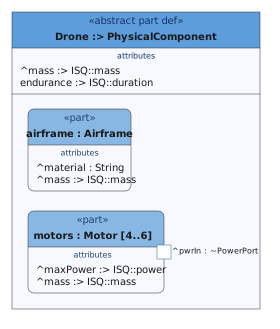
Render one part definition to a PNG file:
syside viz element drone-mission/ -n "DroneMission::Components::Drone" -o Drone.svg
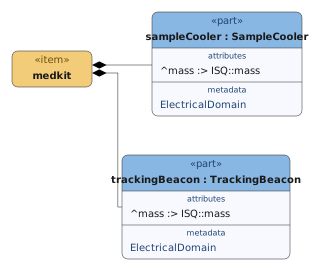
Render a subtree as a two-level decomposition tree:
syside viz element drone-mission/ --render tree -n "DroneMission::Structure::MedicalQuadcopter::medkit" -d 2 -o Medkit_tree.svg
View command
Renders diagrams from SysML v2 views defined in the model. This is the recommended approach for repeatable, version-controlled diagram generation.
See the Diagram views page for defining views and controlling how they render.
Basic usage
syside viz view <paths...>
<paths...>- one or more.sysml/.kermlfiles or directories (searched recursively)
By default, this renders all views found in the model into the ./output directory.
Each view is written as <fileName>.<format>, where fileName is the view’s
fileName attribute. If the attribute is absent, the file is named diagram-<view name>.
Note
Anonymous (unnamed) views are skipped with a warning.
Available options
Option |
Description |
|---|---|
|
Display the help message with all available flags and short descriptions |
|
Render only views at or under this qualified name (e.g. |
|
How many levels of descendants to render. |
|
Render style: |
|
Diagram theme: |
|
Zoom level for rendering. Applicable only to PNG and JPEG output. Overrides the
|
|
Output format: |
|
Directory to write rendered diagrams into (default: |
|
How view filters interact with exposed elements: |
|
Path to a configuration file (see Configure Modeler CLI) |
|
Additional file, directory, or glob pattern to include. Repeatable |
|
Paths or glob patterns to exclude from file discovery. Repeatable |
Usage examples
Render all views as PNG files into a
diagramsdirectory:syside viz view drone-mission/ -f png -o diagrams
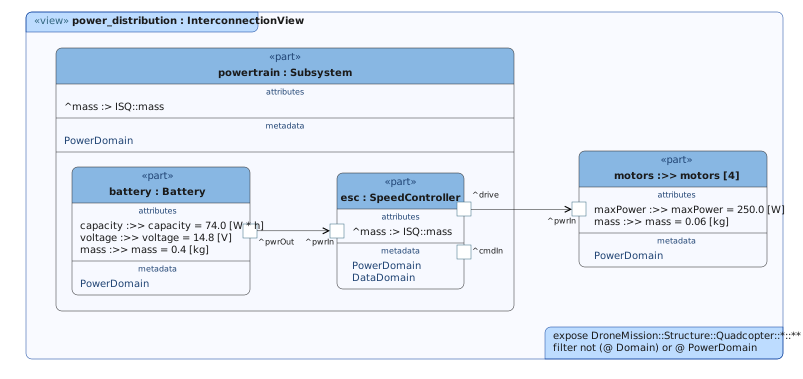
Render a single view by qualified name. The output file is named by the view’s
fileNameattribute:syside viz view drone-mission/ -f png -o diagrams -n "DroneMissionDiagrams::power_distribution"
Exit codes
Viz element and view subcommands exit with the following codes:
Code |
Meaning |
|---|---|
|
Success |
|
Failure due to errors in the model, files that fail to load, or an internal error |
|
Command-line usage error, such as an unknown option or a missing argument |
|
Configuration error, configuration file cannot be read |
|
Nothing to draw. At least one requested diagram matched no elements, so no file was written for it |
Changed in version 0.11.0: A diagram with nothing to draw exits with 4. Before, it exited with 0 and wrote an
empty file.
An invalid [viz] setting no longer exits with 2; it falls back to its default with a
warning (see Visualization settings).
Table command Labs
Export command
Export grid views defined in the SysML v2 model as CSV
files. A hierarchical table exports its whole tree with a leading Level column that
records each row’s depth, as described in Export to CSV.
Basic usage
Pass one or more model files or directories to export all defined grid views into the
output/ directory:
syside table export <paths...>
<paths...>- one or more.sysml/.kermlfiles or directories (searched recursively)
Note
This command exports grid views (table and matrix views) only. Other view
definitions are handled by syside viz view. Passing a
non-grid view to --qualified-name results in an error.
Available options
Option |
Description |
|---|---|
|
Display the help message with all available flags and short descriptions |
|
Path to a |
|
Additional paths to include (e.g. external libraries). These are additional root paths merged with positional arguments for file discovery. |
|
Paths or glob patterns to exclude from file discovery. Matching files are removed from the result. |
|
Qualified names of the views to export. Defaults to all table and matrix views in the model |
|
Save the CSV files to the given directory. Defaults to |
|
Prepend a Byte Order Mark (BOM) to the CSV file to ensure Microsoft Excel correctly detects the UTF-8 encoding and displays special characters properly. |
Note
In SysML v2, element names can contain spaces and special characters (e.g. 'Flight Controller v2' or 'Motor "Type A"'). When passing qualified names that contain
such names, make sure to quote or escape them appropriately for your shell. For
example, names with spaces should be wrapped in double quotes:
syside table export -n "MyPackage::'My Table View'" models/
Alternatively, use simple names without spaces or special characters.